- Section
- Food Security
- Reading time
- 6 minutes
- Published
- September 13, 2026
- Nyéléni declaration
- 27 February 2007, Sélingué, Mali
- Agricultural Land Reserve
- Created in British Columbia in 1973
- Douglas Treaties
- Lekwungen 1850, W̱SÁNEĆ 1852
Starting with the hands
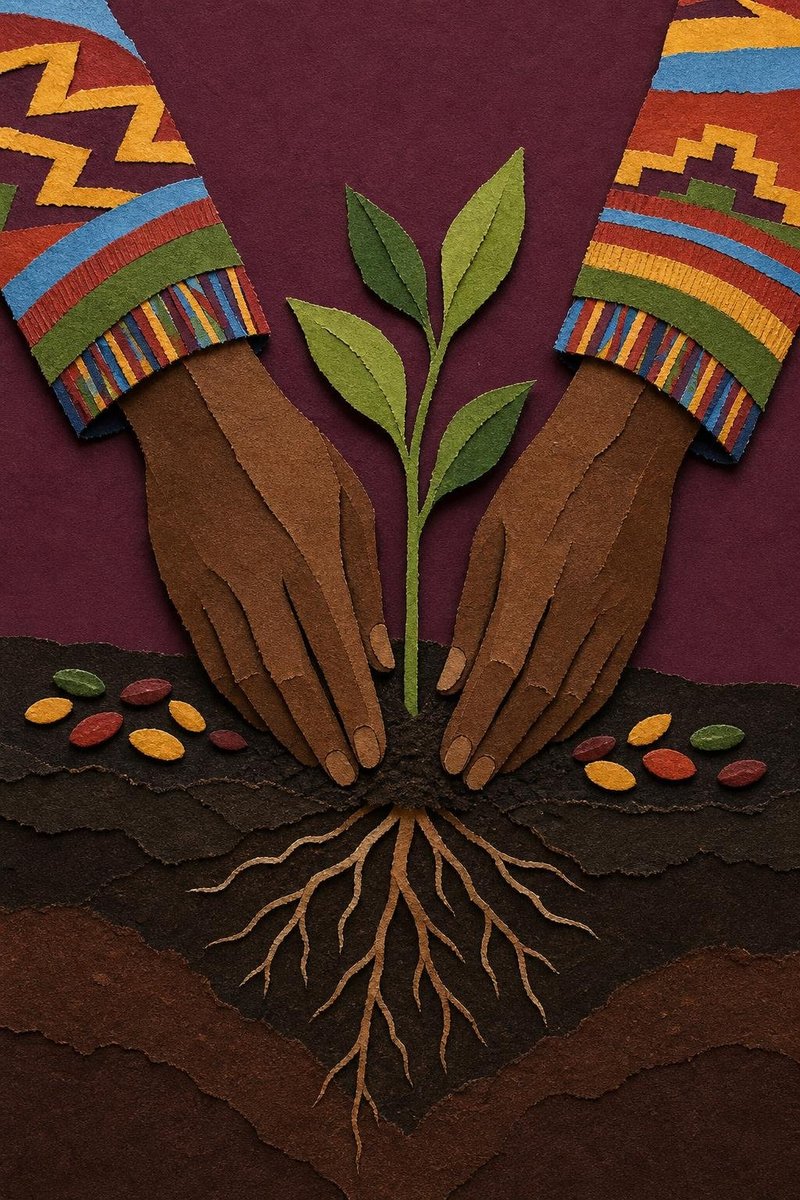
A tray of callaloo seedlings, a hoe, and an afternoon with nothing to do but weed: for many people that is rest. For growers whose families left farms in Jamaica, Nigeria, Haiti or Colombia one or two generations ago, it can also be a way back to something lost in the move. Land-based healing gives that experience a name. Food sovereignty gives it a politics. This piece looks at both, and at what they mean on the southern tip of Vancouver Island, where land is expensive and every field already belongs to someone's history.
What land-based healing means
In Canadian health practice, land-based healing comes largely from Indigenous communities, where programs take people out onto the land for ceremony, harvesting, language and time with Elders as part of treatment for trauma and addiction. The premise is that the land itself is part of recovery.
Black and other racialized communities have taken up related ideas in their own terms. Here the emphasis falls on ancestral foodways and wellness practices: growing the greens a grandmother cooked, saving seed from crops carried across oceans, learning which leaves make a tea for a cough and which are for the pot. A shared harvest, a cooking circle around a pot of Cuban caldosa, or a session pounding fufu can all serve the same purpose. People reconnect with practices that colonialism, slavery and migration broke apart, and they do it with their hands.
None of this replaces clinical care. It adds something clinical care rarely offers: belonging to a place and a tradition at the same time.
Food security and food sovereignty are not the same thing
The two terms are often used interchangeably, but they come from different places and ask different things.
Food security was defined at the 1996 World Food Summit in Rome as a state in which all people, at all times, have physical and economic access to sufficient, safe and nutritious food to meet their dietary needs and food preferences for an active and healthy life. It is a measure of outcomes. Food banks, school meal programs and income supports all work toward it.
Food sovereignty came out of the same moment from another direction. La Via Campesina, the international peasant movement, put the term forward around the 1996 summit as a challenge to trade-led farming policy. In February 2007, more than 500 delegates from over 80 countries met in the village of Nyéléni in Sélingué, Mali, and adopted a declaration that is still the standard reference. The Declaration of Nyéléni describes food sovereignty as "the right of peoples to healthy and culturally appropriate food produced through ecologically sound and sustainable methods, and their right to define their own food and agriculture systems." It goes on to place the rights to use and manage land, water, seeds and livestock in the hands of those who produce food.
Food security asks whether people have enough to eat. Food sovereignty asks who decides.
That difference matters for racialized communities in a concrete way. A family can be fed through a food bank hamper and still have no say over whether cassava, okra or bitter leaf is ever grown within a hundred kilometres. The phrase "culturally appropriate" in the Nyéléni text is doing real work. For the numbers behind food insecurity in Black communities around Victoria, see the companion piece on community-based research.
Land access in British Columbia
Food sovereignty needs land, and land in British Columbia is hard to get.
The province protects farmland through the Agricultural Land Reserve, created in 1973 under the Land Commission Act. The reserve keeps good soil from being paved over. It does not make land cheap, and for a young grower without family land or savings, buying acreage within reach of a city is usually out of the question.
Racialized growers face that barrier and a few more. Many are newcomers without Canadian credit histories. Many know crops that local extension advice does not cover, from amaranth to African eggplant. Some meet the quiet question of whether they belong at the farm gate at all. Provincial statistics on these barriers by race are missing, so most of what is known comes from growers and food organizations themselves.
Some routes do exist. The BC Land Matching Program, delivered by Young Agrarians, pairs new farmers with landholders who have land to lease or share. It began as a Metro Vancouver pilot in 2016, expanded across southern British Columbia in 2018 and reached central and northern regions the following year. Shared sites such as the Sandown Centre for Regenerative Agriculture in North Saanich, community gardens and incubator plots give growers a place to test crops before committing to a lease. The work on culturally relevant crops for Vancouver Island shows what can be grown once there is ground to grow it on.
Most of the land in question was not empty farmland waiting for anyone. It was managed land long before it was surveyed.
Respectful relationships with the Lekwungen and W̱SÁNEĆ peoples
Greater Victoria sits on the territories of the Lekwungen peoples, today the Songhees and Esquimalt Nations, and the W̱SÁNEĆ peoples of the Saanich Peninsula, whose communities include Tsartlip, Tsawout, Pauquachin and Tseycum. Between 1850 and 1854 James Douglas made fourteen agreements on Vancouver Island now known as the Douglas Treaties. The Lekwungen treaties date from 1850 and the two Saanich treaties from February 1852. Governments long treated them as land purchases. W̱SÁNEĆ oral history describes them as agreements of peace that did not surrender most of the land.
The meadows around what is now Beacon Hill Park were cultivated by Lekwungen families for camas, called kwetlal in their language, a staple root and an important trade good. Harvesters lifted the largest bulbs, replanted the rest and used fire to keep shrubs back. Songhees and Lekwungen people have been working to restore that harvest.
For anyone pursuing land-based healing or food sovereignty in the region, this history is the starting point. A Black or racialized growing project on Lekwungen or W̱SÁNEĆ land is reconnecting with its own ancestry on someone else's ancestral ground. Respect takes practical forms: learning whose territory a plot is on, following protocols set by the Nations, not planting over or harvesting from sites that carry meaning, and supporting Indigenous food sovereignty work such as camas restoration when asked.